For those looking for suggestions on your next literary escape, I’ve had another fairly good month.
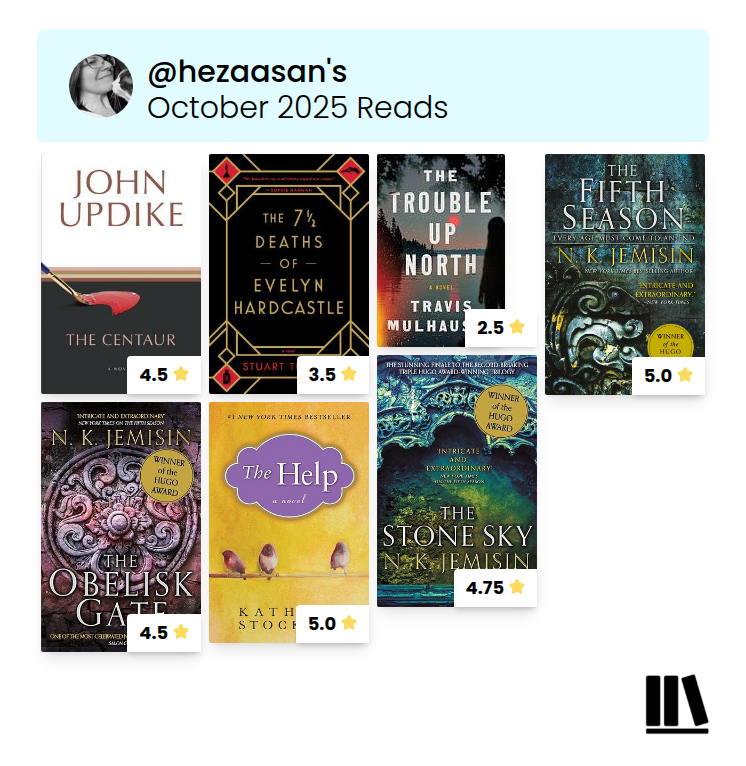
I kicked things off with a classic myth transported into the 1960s, saturated with haunting prose and deliberate conflation of which god(dess) and hero(ine) was who, and when, and how. John Updike’s “The Centaur” turned my brain into a pretzel, complete with extra salt and a side of cheese dip. This was one of my favorite reads of the year.
They weren’t all winners. I slogged through a so-so time-binding mystery (“The 7/12 Deaths of Evelyn Hardcastle”) and a lower than mediocre small town crime yarn set in Northern Michigan (“The Trouble Up North”). The effort pulled me out of my usual genres for a few, though, which made it worthwhile in its own way.
Fortunately my luck shifted, when I happened to mention to a coworker that I was on a hunt for another powerful experience like the Updike. The triple Hugo award-winning Broken Earth trilogy by N.K. Jemisin thus entered my life and a permanent place on my bookshelf. Written while Jemisin was facing her own mother’s slow, grueling, terminal illness and all the psychological turmoil that comes with it, this imaginative tale is fraught with sociopolitical depth as much as it is an intensely personal journey, blending magic with intricate dystopian world-building informed by then-current science of astrophysics and biology, and action/adventure with brilliant turns of phrase. I stayed up far too late on several weeknights reading all three in the span of a couple of weeks and don’t regret a single minute of it.
I did take one break — between book 2 and 3 of the above — to dip back into the world of bestsellers turned films with “The Help” and was utterly enchanted. There were also unexpected parallels between this piece, set in the deep South in the 1960s, and the themes in Jemisin’s universe: the effect of institutionalized racism and backlash against the fight for treating everyone like decent, equal human beings. It was a chilling read, for those reasons and more. The experience was all the better for what was written in the afterword from the author, a confession of sorts about what it was like for her, a white woman, to write in the voice of the black women like those who served her family. Yet another for the year’s “best” list.
And so it goes.
 Muttering Retreats